Tuesday, September 28, 2010

A is for Adventure

…and Aruba is where we found some this past week, the trip my husband’s much-deserved reward for a complete recovery after three months of illness and tests, then two surgeries and a post-surgical infection, (yes, poor guy, but he has a loving, supportive wife that saw him through.)

DSCN6002

Aruba greeted us with white sands, blue skies and the rhythmic sounds of waves hitting the shore. 

DSCN6004

We stayed at the Bucuti Beach Resort, a Dutch-owned hotel in the low-rise district on Eagle Beach.

However, Aruba also greeted us with showers and incredible thunder storms that brought the most rain the island has had in one week in the past 60 years.

So the weather would be sunny, then cloud up -- and then…

DSCN6010   DSCN6013

thunder and lightning and pounding rains!! Of course, Aruba is a semi-arid island with an average rainfall of about 15”, so they don’t have much in the way of a public drainage system.

DSCN6040

Which meant that basically everything flooded, from houses to roads. It felt very adventurous to try and drive around.

Back at the hotel, we’d enjoy the sun one hour, run for cover the next as storms assailed us -- and then a few hours later, be back on the beach stretched out in beach chairs again with everyone else.DSCN5971

This was our romantic little bungalow on the beach, where I could snuggle up on the veranda and watch the storms, then run back out to swim in the ocean when the skies cleared.

I spent so much time in the ocean that I can still close my eyes, feel myself floating in the water and hear the rhythm of the waves on the sand. Ahhhhhh…

Thursday, September 16, 2010

Fiber Lovers Day at SU


My long-time desire to forge meaningful connections among fiber artists led me to take on the job of NYS rep for the Surface Design Association two years ago.

I’ve been working on program ideas that could increase interest in SDA membership. On Saturday, September 11,  SDA New York successfully launched a pilot program, “SDA at SU Fiber Lovers Day” at Syracuse University that was open to all who were interested in attending.

Partnering with the wonderful Eileen Gosson on the Surface Pattern Design faculty, we planned a day packed with tours, exhibits and presentations.

DSCN5931 

Mary Giehl, faculty, chats with the group about the fiber program in the SU surface design classroom.

DSCN5946  Sarah Saulson, faculty, introduces the SU weaving facilities. 

DSCN5953

Illuminated weaving by SU undergrad Elin Sandberg.

DSCN5922

MFA student Holland Webster gave a brief talk about this installation, which she and a fellow grad student completed over the summer, based on a study of pods and pod shapes, for the 150 foot hallway of the Shaffer Building.

DSCN5919

Installation detail. The student work was inspiring.

 DSCN5964

After a break for lunch, presentations in the afternoon included grad students Jooyoung Ha, Caitlin Foley and Holland Webster  and SU Fiber and Surface pattern Design faculty Sarah Saulson, Anne Cofer, Mary Giehl and Eileen Gosson.  Jan Navales, shown here, a local artist, also spoke about making a living in fiber art.

We closed the day with attendees introducing their work, then enjoyed the reception and opening for “”Pliable Planes: Cloth and Beyond” at the Warehouse Gallery.

It was an exceptional day. Wish you could have joined us!

Thursday, September 9, 2010

Exciting Week

You’ll find a well-written, thoughtful article about my Pages pieces at The Textile Blog. I can’t thank John enough for selecting me and doing such an excellent job at communicating the ideas that generate these works. 

The second reason this week was exciting is that I accomplished a long time goal. I entered Quilt National with three cohesive works. I finished the third one on Tuesday morning, had them photographed on Tuesday afternoon and sent my submission out via UPS on Wednesday for delivery by the Friday September 10 (yes that is tomorrow) deadline. So much for taking it easy.

Never mind that most of my work is no longer finished as quilts. I’ve been focusing on textile constructions this entire year, but then Relic 4 appeared. I’ve posted another detail of this work before but here’s a reminder image. I decided to finish it as a wall hanging and enter it.

 Beck_Relic4_detail

Relic 4, detail. This piece is silk backed with canvas and is 48” high and 43” wide.

So then I needed two more works to provide a stronger entry. Which meant that although I vowed to take the rest of the summer off and just play after my solo and my husband’s surgeries, I ended up working even harder to meet this deadline. It turns out that working at making art IS my play.

Beck_Relic5_detail

Relic 5 detail. The work is 54” high and 64” wide. It’s a rocky surface peppered with layered graffiti, weathered and faded in places. It’s dyed, painted and printed silk habotai backed with cotton canvas.

QN’s policy is that works submitted or accepted not be displayed anywhere prior to the Quilt National opening. They will disqualify work that has been exhibited anywhere other than on the artist’s website.

Beck_Relic6_57x31

 Relic 6, detail. Three stitched, silk broadcloth panels hang side by side; together they are 31” wide and 57” long.

Beck_Relic6_detail

A second detail. This piece is absolutely lovely and I know it will sell quickly. Some of the screened texts on it are from writing samples that readers of this blog have sent to me. Thank you – there will be more of these.

So I’m posting details rather than the full pieces until the jurors make their choices. Notification will be in early October.

Wednesday, September 1, 2010

Sunday Art Buffet -- Tasty

To top off a marvelous weekend with cousins at the 80th birthday party for my Aunt Helen in Springfield, Massachusetts, we veered off the main highway and drove up Route 7 on our way home to check out Mass MOCA.

Fortune smiled on my art loving self, because that route also led by The Clark Museum in Williamstown, so we drove in to check out the “Picasso Looks at Degas” exhibit, where works by the two artists were displayed side by side and emphasized the extent to which Picasso studied, responded to and was influenced by the elder artist’s work. DSCN5815
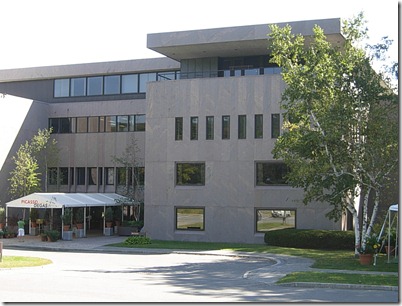
Entrance to The Clark. We arrived at 10 AM when the doors opened and by the time we left an hour later, the parking lots all around the building were completely full.

From there we drove on to North Adams and Mass MOCA, an amazing complex of factory buildings that opened in 1999. The buildings were restored and refurbished to house large scale installation works by contemporary artists.
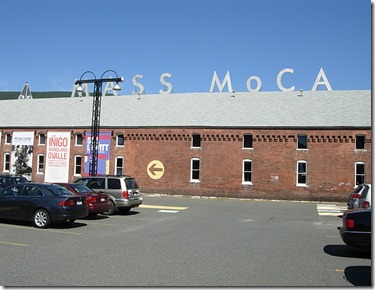
DSCN5822 

Currently on exhibit there is a retrospective of Sol Lewitt’s work and “Material World”, an invitational in which seven artists were invited to transform the second and third floor galleries with installation pieces. All the artists selected are known for their use of modest, everyday materials. Each has produced a massively scaled work  that responds to and interacts with the industrial environment of the space.

DSCN5841

DSCN5845

White Stag, 2009-2010. Paper, wood by artists Wade Kavanaugh and Stephen B. Nguyen. Twisted, crumpled and draped rolls of paper created this old growth forest, an enormous installation that spanned two floors.

DSCN5825

DSCN5828

Big Boss, 2009-2010. Rope, paint, by Orly Genger. The exhibit brochure reveals that the artist knotted (in an adapted crochet stitch) and painted over 100 miles of rope. Responding to the male-dominated world of sculpture, Genger’s work pumps up this traditionally female-identified craft process to the level of Olympic physical prowess. It is forceful and  --surprisingly -- simple and familiar at the same time.

It becomes evident in viewing all the works that just how intensely physical the act of making them must have been.

The Sol Lewitt retrospective, which I expected to just appreciate as a viewer, turned out to be inspiring and informative to me as an artist, both in the sheer volume of the artist’s productivity and diversity of explorations and the philosophy and thought that led to his separation between artistic ideas and their execution.

DSCN5867

LeWitt numbered his “wall drawings” rather than naming them. He engineered specific directions for each work’s creation, which are executed by artists and students at specific sites. The process is labor intensive and exacting and ephemeral. Often the walls are painted over and the paintings disappear when an exhibition closes. Mass MOCA is displaying this retrospective installation of  105 of the artist’s work for 25 years.

My personal favorites are the graphite pieces that LeWitt created both in his earliest works and then returned to at the end of his life. The final works appear luminous; they are comprised of carefully measured bands and densities of hand-scribbled lines using just graphite pencil lead.

DSCN5876

DSCN5877

The exhibit brochure copy describes these works as “transcendent.” I can’t help but agree.

Saturday, August 21, 2010

Vacation Week

My final studio day before heading off to our cottage was a productive one. My new piece is almost ready for the language imagery that will complete it – before I left for vacation, my thoughts took a sudden, playful fork.

DSCN5757 A quick attempt to get some ideas put down on cloth.  In previous Relic pieces, I marked the surfaces with ancient inscriptions. Then I began to realize that “ancient” is a relative term – today many people consider the 1950’s ancient.  My mind is toying with creating a surface that reflects one young man’s desire for the world to remember him.

BUT FIRST – Off to the Lake!

 DSCN5766

Our small slice of summer perfection – a quiet week at our cottage in Central New York on Panther Lake, a lake so small it looks like a pinpoint on the map!

Perfect summer weather made our time at the cottage a joy. In between kayaking and paddle boating and swimming, I kept the creative fires stoked by reading contemporary drawing books and doing some experimental sketching.

DSCN5773

I alternated between making lines and shapes with various pens and graphite and charcoal pencils…

DSCN5763

…and even had time to explore the area for interesting hand-lettered signage.

A great vacation!

Saturday, August 14, 2010

Essential Design Tools

How do you work through your design ideas as you are composing a work? The best resources I have for stepping back and looking at my work objectively are my  Coolpix digital camera and photo software.

In the years before I used this dynamic duo:

  • I took Polaroid pictures and hung them on my design wall.
  • I turned away from the wall and held up a pocket mirror and looked at the work in it backwards.
  • I  removed my glasses and squinted.
  • I looked at it in the dark so just the value contrasts stood out.
  • I turned it a quarter turn and viewed it from each orientation to see what it revealed about my composition.
  • I carried my piece from room to room, laid it over a couch or chair and then let my eye catch a glimpse of it each time I passed through.

Now, I shoot images of the work on my design wall and can immediately load and view them on my computer to evaluate where I am.

I’ve spent this week working on the fifth Relics piece. Here’s some details of its evolution to date:

DSCN5660

One layer of monoprinted dye on the silk – this is a detail – the full  piece is 65” long x 55” high. At first a vertical orientation, I changed it to horizontal.

DSCN5695

First layers of added dye painting. It definitely does not look aged yet.

DSCN5703

Beginning to define the lines and crevasses.

DSCN5728

Adding more color.

Friday detail

Deepening and darkening areas. My intention with each layer is to age the surface and create more visual depth and definition. I’ve shifted now from dyes to paints. This is a detail of where I left this new piece yesterday.

I am still adding line work and defining the crevasses. Once that’s done, I will be ready to add the language elements to the surface that suggest ancient inscriptions -- or possibly play on the “ancient writing” theme with some 20th century graffiti.

Whether this piece ends up on the “sample” pile to be made into smaller works or actually proves to be successful on a large scale, it is teaching me a lot.

Thursday, August 5, 2010

Process Notes: Painted Archaeologies

 DSCN5672

One of  two new pieces on my print table, still wet from creating an underpainting on the monoprinted surface.

A newly completed work is a rich resource of  “coulda shoulda wouldas” – not in a critical sense, more in an “imagine if…” context. A great jumping off place for a new work is to respond to the one that’s just been completed. If you did it again, what would you do differently? What would make it richer, more compelling, more articulate?

Having just put the finishing touches on the fourth piece in my Relics series, I am working through my responses to this one – both the likes and dislikes – on two new pieces.

In these, I hope to explore variations on color, composition  and marks that can best convey the feel of ancient writings scrawled or carved on aged, worn, eroded surfaces .

DSCN5629

Here’s a snippet of  Relic 4.  I can’t show the whole image because I’m considering entering it in  an international juried exhibition that prohibits any images of accepted works being reproduced or exhibited prior to the show opening.